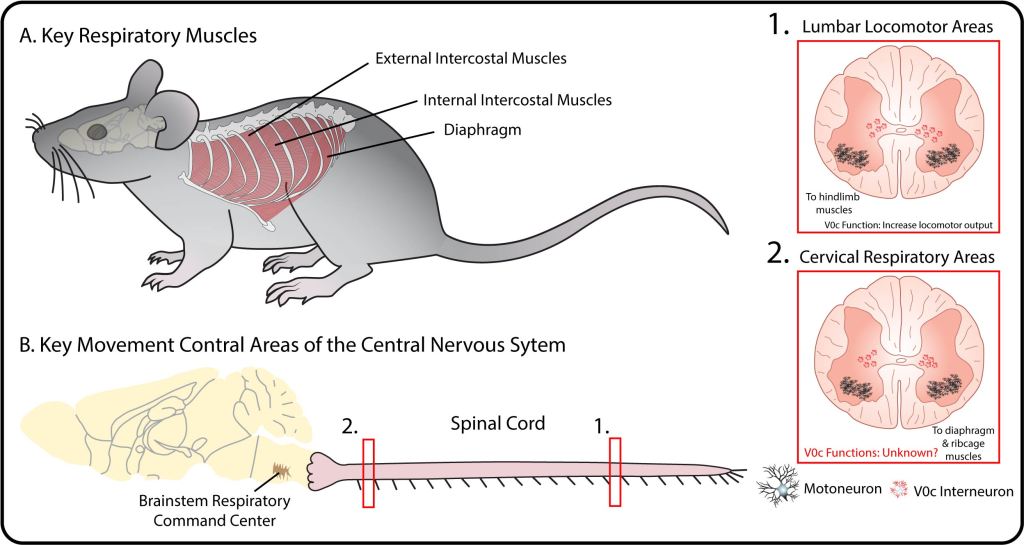
Breathing is undeniably one of the more important motor functions that we must perform. It must persist from the first breath that we take when we are born and continue until we die. Breathing must also be adapted to meet constantly changing metabolic demands, such as those imposed by movement. Therefore, the underlying neural networks that generate breathing must not only be robust, but also adaptable.
Under resting conditions, the inhalation of air into the lungs during the inspiratory phase of breathing, is exclusively driven by contraction of the diaphragm muscle, with exhalation of air during the expiratory phase produced by it’s passive relaxation. Remarkably, the respiratory system somehow knows how to predict metabolic needs that occur in response to movement. In anticipation for movement, breathing volume is increased – inspiration is facilitated through the recruitment of additional accessory respiratory muscles (external intercostals, abdominal, scapular elevator muscles). Further, expiration becomes active through the recruitment the internal intercostal and abdominal muscles. The mechanisms that underlie this feed-forward recruitment of respiratory muscles are not yet known. We think that local circuits in the cervical spinal cord might play a role in producing this activity-dependent recruitment of accessory respiratory muscles.
Leveraging tools and expertise derived from studying spinal locomotor circuits, we are working to reveal novel mechanisms that contribute to state-dependent facilitation of breathing. Current areas of study include:
- A spinal cholinergic circuit for the control of breathing
- Diversity of spinal V2a interneurons in respiratory circuits
- Ascending control of breathing as a therapeutic target following spinal cord injury
Breathing is impaired following spinal cord injury and in a collection of neurological disorders. Consequently, this dysfunction often leads to pneumonia or secondary cardiopulmonary complications, severely compromising quality of life. Interestingly, in many of these conditions patients present with a resting respiratory muscle activity pattern that is more typical of those found in healthy people during active states. Therefore, understanding fundamental mechanisms that underlie activity-dependent recruitment of respiratory muscles will provide insights that may lead to the development of rehabilitative strategies or therapeutic targets to attenuate respiratory dysfunction in disease. This is a particular focus of my ongoing work in the Crone Lab, which aims to understand pathways that couple locomotor circuits in the lumbar spinal cord with respiratory circuits in the cervical spinal cord and brainstem and target these therapeutically to promote recovery of breathing following spinal cord injury.
Outputs
Lin, M.*, Calabrese, G.B.*, Incognito, A.V., Moore, M.T., Agarwal, A., Wilson, R.J., Zagoraiou, L., Sharples, S.A.+, Miles, G.B.+, Philippidou, P. +. (2025). A cholinergic spinal pathway for the adaptive control of breathing. Cell Reports. 44(8). 116078. DOI: 10.1016/j.celrep.2025.116078. + Corresponding Authors
Calabrese, G.B., Lin, M., Incogneto, A., Wilson, R.J., Zagoraiou, L., Sharples, S.A.*+, and Miles, G.B.+, Philippidou, P. +. A cholinergic spinal pathway for the amplification of breathing. Kentucky Spinal Cord and Head Injury Research Trust Symposium. Louisville, KY, USA. May 2024. *Selected for Data Blitz
Calabrese, G.B., Broadhead, M.J., Schardien, K., Incognito, A., Lane, M.A., Wilson, R.J., Sharples, S.A., and Miles, G.B., Modulation of Breathing by spinal cholinergic pathways. Society for Neuroscience, Washington, DC, USA. Nov 2023.
Calabrese, G.B., Sharples, S.A., Lin, M., Ingognito, A., Wilson, R., Zagoraiou, L., Philippidou, P., and Miles, G.B. Modulation of respiratory-related motoneuron output by spinal cholinergic interneurons. International Motoneuron Society Meeting. Bordeaux, France, June 2024
Calabrese, G.B., Broadhead, M.J., Incognito, A.V., Motherwell, L., Wilson, R.J., Sharples, S.A., and Miles, G.B. Spinal cholinergic modulation of spinal circuits for breathing. Motor Control: Spinal Circuits & Beyond. St Andrews, UK. June 2023.
Calabrese, G.B.*, Broadhead, M.J., Motherwell, L., Sharples, S.A., and Miles, G.B. Cholinergic modulation of respiratory-related motor output. Society for Neuroscience. San Diego, CA, USA. Nov 2022.
Calabrese, G.B.*, Broadhead, M.J., Motherwell, L., Sharples, S.A., and Miles, G.B. Cholinergic modulation of respiratory-related motor output. International Motoneuron Society Meeting. Banff, AB, Canada, June 2022
Funding



 Simon A. Sharples, PhD